Sep 9, 2026 · 19 min
Conics: What Are These Curves Used for in Our Cities?
From monuments to antennas, follow conics, the geometric curves found in our cities. This podcast explores their uses and finds them in art, too.
Collections containing this episode (4)
Original Tangente content, adapted into a podcast with the help of AI and validated by our editorial team. How does it work?
Transcript
Show transcriptHide transcript
Automatic transcript
Speaker 1
Welcome to the podcast from Tangente magazine, and thank you for joining us for this deep dive. Today, we are basically peeling back the plaster, the bricks, the concrete of the city around you.
Speaker 2
Yeah, exactly. Because, you know, usually when we walk down the street, we're just focusing purely on the surface, right?
Speaker 1
Right. I mean, we see the heavy stone of a cathedral or the steel beams of a subway station, and we just accept them as these massive, solid objects. But our mission for today's deep dive is to look past all that surface stuff.
Speaker 2
We want to reveal the pure kind of invisible forces holding it all up.
Speaker 1
Exactly.
Speaker 2
And to do that, we have to talk about conics.
Speaker 1
Right. The mathematical concept of conics.
Speaker 2
So specifically, we're talking about ellipses, parabolas and hyperbolas. And yet we're taking them out of those dusty geometry textbooks and really looking at them as the hidden structural magic of the everyday world.
Speaker 1
Because they're definitely not just like abstract equations living on a chalkboard.
Speaker 2
No, not at all. Throughout history, architects and engineers and even artists really have actively chosen these very specific mathematical curves.
Speaker 1
Because of their unique properties, right? Like mechanical, acoustic and aesthetic benefits.
Speaker 2
Yeah, exactly. They solve very real physical problems.
Speaker 1
So by the time we finish this sort of walking tour of architecture and engineering, I promise you, you will never look at a city skyline, a church vault, or honestly a power plant the exact same way again.
Speaker 2
The math is quite literally hiding in plain sight.
Speaker 1
It really is. So let's start with human history's most famous gathering places. When you're dealing with huge crowds, you need a shape that solves spatial crowd control problems and complex acoustic problems all at once.
Speaker 2
Right. And that brings us to the classic elongated circle, the ellipse.
Speaker 1
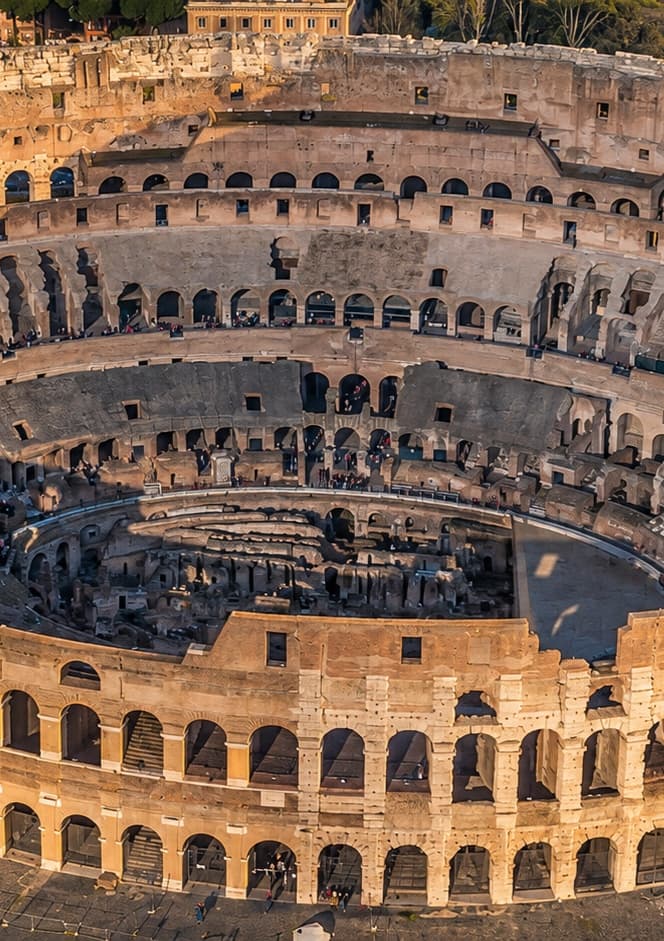
When you look for an ellipse in the real world, I mean, the ultimate historical example most people picture is the Colosseum in Rome.
Speaker 2
Oh, absolutely. Viewed from above, it just has that massive, iconic, stretched out shape. I mean, the dimensions are colossal. It measures 187 meters on its long axis and 155 meters across its shorter axis.
Speaker 1
But I actually want to push back on that immediately because every guidebook you ever read calls the Colosseum an ellipse, but the engineering reality is actually way more complicated than that.
Speaker 2
Oh yeah.
Speaker 1
Is it actually a mathematically true ellipse?
Speaker 2
Well, the answer is surprisingly murky, to be honest. Modern researchers, experts like Giuseppe Cozzo and Camilla Trevisan have really dug deeply into the underlying geometry there. And along with people like Paul Rosen and Emmanuel Trucco, their findings suggest that the real curve might actually be what's called a polycentric oval.
Speaker 1
OK, meaning it wasn't drawn using just one continuous mathematical rule.
Speaker 2
Exactly. It's stitched together from multiple different separate curves.
Speaker 1
Stitch together is a really great way to visualize it. So a polycentric oval is basically constructed from several different arcs of standard circles, right?
Speaker 2
Yeah. And they're just perfectly blended at the edges. So it looks like one continuous sweeping line.
Speaker 1
But why? Like, why would Roman engineers fake an ellipse using overlapping circles? I mean, a circle is incredibly simple to draw.
Speaker 2
Right. You just plant a stake in the ground, tie a rope to it, pull it taut and walk in a circle.
Speaker 1
Exactly. But drawing a true ellipse requires plotting two separate focal points, right? You have to keep constant tension on a moving loop of
Speaker 2
rope. And at 187 meters scale, that rope is going to stretch and sag and just completely ruin the math.
Speaker 1
So staking out multiple standard circles using fixed ropes is just something ancient surveyors could execute with much higher precision?
Speaker 2
Exactly. It was a practical engineering choice.
Speaker 1
But you know, that still leaves the question of why they went through the massive headache of calculating a polycentric oval in the first place. Why not just build a massive, simple, circular arena?
Speaker 2
Well, it comes down to geometric efficiency, basically, and crowd optimization.
Speaker 1
Right, because of the surface area.
Speaker 2
Yeah. If you take a given amount of surface area, an elliptical or oval shape gives you a significantly longer perimeter than a perfect circle does.
Speaker 1
Oh, so a longer boundary line means you can build longer rows of front row seating.
Speaker 2
Exactly. You can pack in more spectators who maintain a relatively close, highly visible sight line to the action in the center.
Speaker 1
Because if they had built a perfect circle with the exact same square footage, those seats would have been pushed incredibly far back. It would have ruined the view for thousands of people.
Speaker 2
Right. They essentially physically stretched the blueprint to manipulate the seating chart.
Speaker 1
Which is just brilliant. But, you know, the ellipse doesn't just manage physical bodies in a space. It also perfectly manages invisible waves like sound.
Speaker 2
Which is fascinating.
Speaker 1
Yeah. And this brings us to whispering galleries.
Speaker 2
All right. To really understand the acoustics there, you have to understand the defining geometric rule of an ellipse.
Speaker 1
Which is the focal points, right?
Speaker 2
Yeah.
The rest of the transcript is for subscribers.
SubscribeListen next
Episodes that share a playlist, a figure or a field with this one.
Sep 9, 2026 · 25 min
Jul 3, 2026 · 23 min

Jun 8, 2026 · 20 min
Oct 9, 2025 · 20 min

Jul 9, 2026 · 6 min

Apr 22, 2026 · 24 min