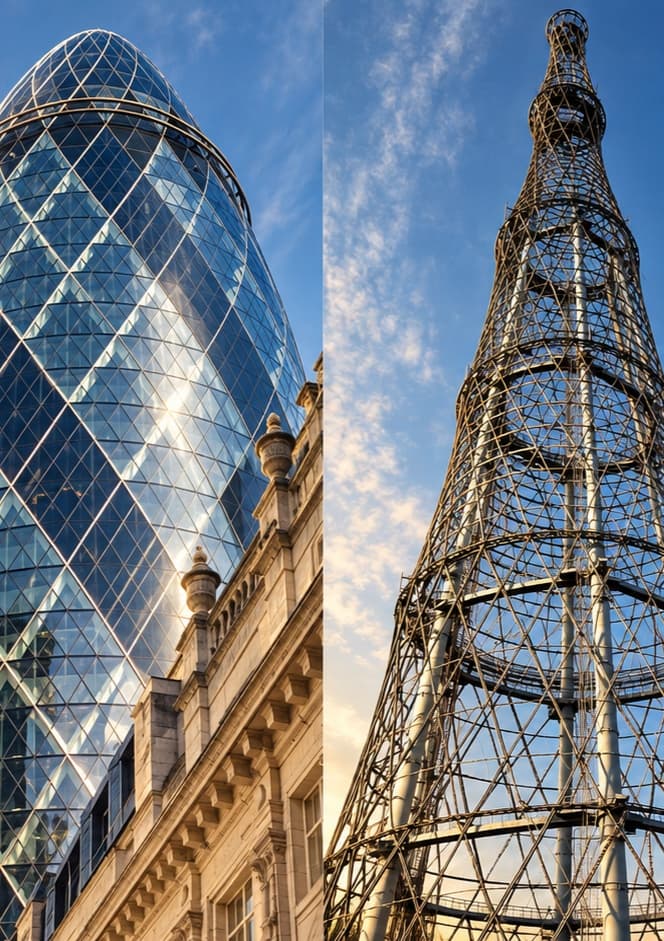
Sep 9, 2026 · 25 min
Building lighter: what quadric surfaces make possible
Quadric surfaces, mathematical surfaces in three dimensions, can make some structures lighter. Follow this podcast from shapes to buildings to understand the role of their geometry.
Collections containing this episode (6)
Original Tangente content, adapted into a podcast with the help of AI and validated by our editorial team. How does it work?
Transcript
Show transcriptHide transcript
Automatic transcript
Speaker 1
Welcome to the podcast from Tangente magazine and welcome to our listeners. I want you to do something for me. Just take a second and look around your physical space.
Speaker 2
Yeah. Whether you're like walking down a city street right now or just looking out a window at a skyline.
Speaker 1
Exactly. We usually think of those buildings as the result of heavy engineering, like steel, concrete, glass, sweat, and just millions of dollars of raw materials.
Speaker 2
Right. It's an incredibly physical process.
Speaker 1
It is. But I want you to imagine if the buildings you see weren't just engineered. Imagine if they were literal physical manifestations of mathematical equations.
Speaker 2
It's a really profound way to view the built environment. Just the idea that a purely abstract formula, something drawn on a chalkboard centuries ago, is actively dictating the shape, the environmental efficiency, and the structural strength of the space you're sitting in right now.
Speaker 1
And that is our mission for today's deep dive. We are unpacking a piece from Tangente magazine that explores something called quadrics.
Speaker 2
Which are fascinating.
Speaker 1
Oh, totally. The sources reveal how just a simple shift in an algebraic equation, like literally changing a plus sign to a minus sign on a chalkboard, determines whether a building is going to be this ultra-efficient, energy-saving skyscraper, or a towering structure made entirely of straight lines that somehow forms a perfect sweeping curve.
Speaker 2
But before we can look up at the skyline and understand how those structures work, we really need to, like, look down at the mathematical DNA of these shapes. Right. We have to establish what a quadric actually is, and the history behind it is quite a marathon.
Speaker 1
So let's unpack the math. Based on high school geometry, I mean, most of us know what a conic is, right?
Speaker 2
Right, a two-dimensional curve.
Speaker 1
Yeah, we're talking about shapes like an ellipse, a parabola, or a hyperbola.
Speaker 2
Exactly. So take those two-dimensional curves and pull them out into three-dimensional space. A quadric is essentially the 3D cousin of a conic.
Speaker 1
Okay.
Speaker 2
So your ellipse becomes an ellipsoid, your parabola becomes a paraboloid, and your hyperbola becomes a hyperboloid.
Speaker 1
And the source material actually highlighted a really fascinating linguistic quirk about this transition because, you know, the original text was written in French.
Speaker 2
Oh, right. The gender flip.
Speaker 1
Yeah, in French, the two-dimensional curves, the ellipse, the parabola, those are all feminine words. They just inherited that from the original Greek terms. But the moment they get pulled into three-dimensional surfaces, the ellipsoid, the paraboloid, the grammatical gender literally flips. The words become masculine.
Speaker 2
It serves as this really charming reminder that language has its own unpredictable architecture, you know?
Speaker 1
Yeah, totally.
Speaker 2
But mathematically speaking, the architecture of these 3D surfaces starts out incredibly chaotic. We are dealing with second degree polynomials involving all three coordinates of space, the X, Y and Z axes.
Speaker 1
Right.
Speaker 2
And in its general, unsimplified form, the algebraic expression for just one of these shapes contains 10 different terms interacting with each other.
Speaker 1
Ten intersecting terms. That just sounds like a nightmare to try and visualize or plot even. Oh,
Speaker 2
it was. Reading through the history, this wasn't something a single person just figured out in a weekend. It was very much an intellectual relay race.
Speaker 1
Over a long time, right?
Speaker 2
Generations, yeah. Starting in the 17th century, mathematicians spent over 100 years trying to decode these 10-term equations. You had Christian Huygen studying hyperboloids, then Leonhard Euler made a massive leap by managing to classify all of them in 1748.
Speaker 1
But the math was still messy.
Speaker 2
Incredibly dense and unwieldy. It required another century of brilliant minds. Carl Friedrich Gauss in 1801. Augustine Louis Cauchy after him. And finally, a mathematician named James Joseph Sylvester in 1852. He was the one to truly crack the code.
Speaker 1
Right. Sylvester is the one who figured out how to tame the 10-term mathematical monster using matrix algebra.
Speaker 2
Exactly.
Speaker 1
But what struck me in the sources is how that actually works conceptually. Because matrix algebra essentially allows you to change your frame of reference.
Speaker 2
Right. Your perspective.
Speaker 1
Yeah, like if you have a messy, tilted, complex 3D shape, the math to describe it is just awful. But Sylvester proved that you can mathematically rotate your camera, your perspective, until the shape aligns perfectly with the standard x, y, and z axes.
Speaker 2
And when you do that, all the complex, messy terms cancel out, leaving you with just the coordinates squared.
Speaker 1
Which is a monumental simplification.
Speaker 2
Huge. Sylvester established that when you boil the equation down to this canonical form, you are left with a specific number of positive, negative, or zero coefficients sitting in front of those squared coordinates.
Speaker 1
Okay.
Speaker 2
Mathematicians call this the signature. It acts as a permanent mathematical ID card for the shape. The signs of those numbers dictate the fundamental nature of the surface in three-dimensional space.
The rest of the transcript is for subscribers.
SubscribeListen next
Episodes that share a playlist, a figure or a field with this one.
Oct 9, 2025 · 20 min

Apr 22, 2026 · 24 min
Jun 11, 2025 · 24 min
Sep 9, 2026 · 19 min
Jul 3, 2026 · 23 min

Jun 8, 2026 · 20 min